
Recommended Reading: Paved Paradise
How parking explains everything in city planning

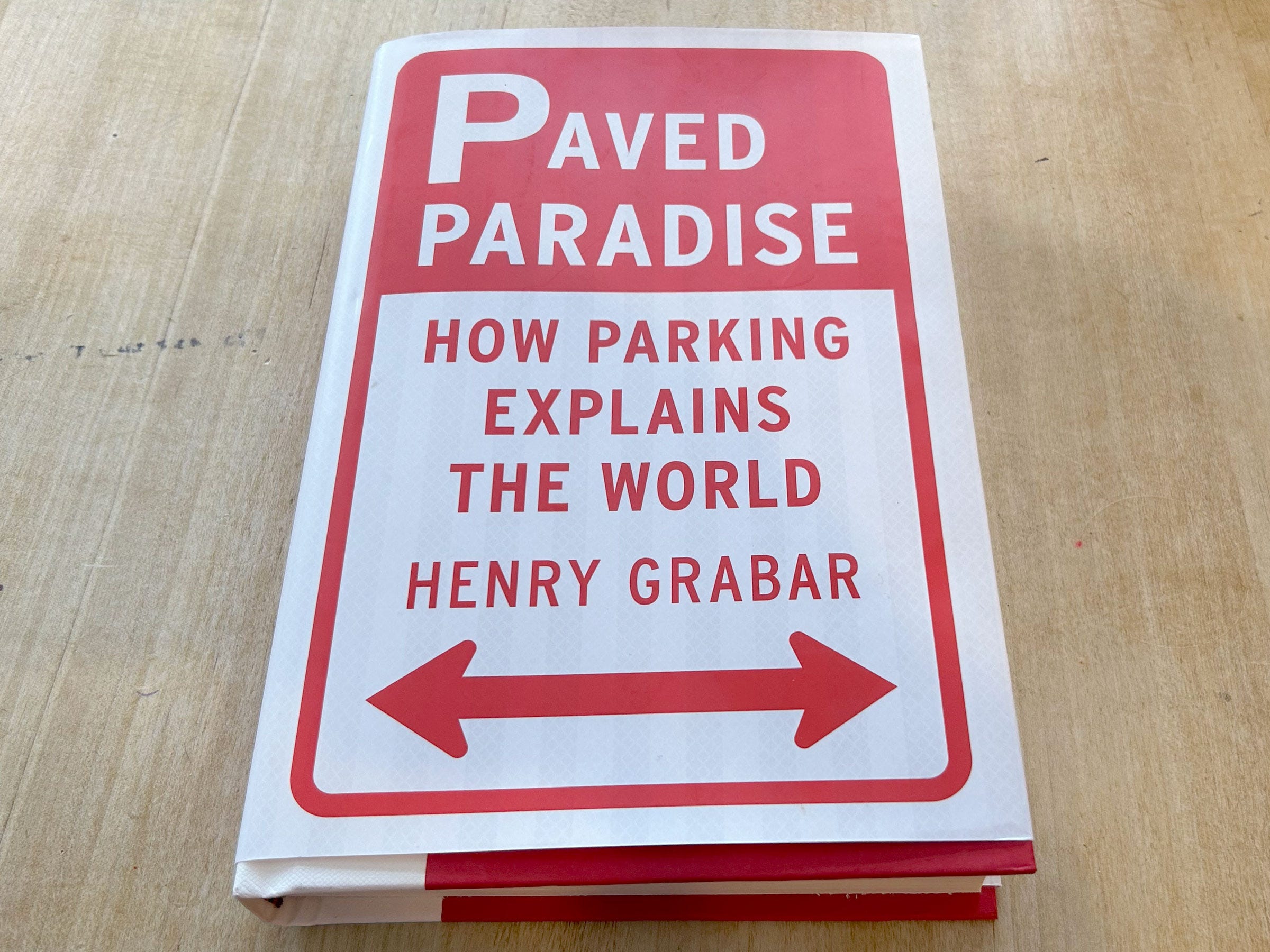
Parking. Ugh.
Parking is the bane of a city councillor’s existence. It’s in the top three categories of complaints we get from ward residents. I often joke that our Planning and Housing Committee should be re-named the Parking and Housing Committee, given how frequently questions around parking dominate our discussions.
I loved Henry Grabar’s book about parking though. It’s called Paved Paradise: How parking explains the world.
Here’s a description from the book sleeve:
“In the century since the advent of the car, we have deformed - and in some cases demolished - our homes and our cities in a Sisyphean quest for cheap and convenient car storage. Much of the nation’s most valuable real estate is now devoted exclusively to empty and idle vehicles, even as so many Americans struggle to find affordable housing…
Parking determines the design of new buildings and the fate of old ones, patterns of traffic and the variability of transit, neighborhood politics and municipal finance, the quality of public space, and even the course of floodwaters.”
The book is about how North America ended up with a vast oversupply of parking, and what that has done to the shape of our cities and buildings: more expensive housing, uglier architecture, less open space, and sprawl. In the United States, Grabar writes, more square footage is dedicated to parking each car than to housing each person.
One of the main culprits is minimum parking requirements imposed by cities through zoning by-laws and other legislation. Ottawa suffers from this too. Our zoning by-laws are a bit of a mess when it comes to stipulating parking minima. They’re usually determined by building use and building form, but the rules often contradict and work against more important goals, especially affordability. The cost of building a parking spot can be tens of thousands of dollars, which gets passed on to new buyers or tenants – whether or not they need the parking spot.
A very small example of where these rules don’t make sense: stacked townhomes in suburban Ottawa require 1.2 parking spaces per unit, whereas back-to-back townhomes require 1.0 parking spaces per unit. This is regardless of their size or number of bedrooms or any other factor that might suggest a higher level of car ownership, or neighbourhood walkability scores. Nobody knows why these rates were set differently.
Most cities (including Ottawa) have carried over parking requirements from one by-law update to another, without examining whether the underlying assumptions make sense. A lot of the planning standards for parking minima stem from engineering guidelines in the 1970s. So we’re making decisions on parking today that are based on travel patterns (and cultural values) from 50 years ago.
Many cities in North America have eliminated minimum parking requirements, including Edmonton. The idea is to have the market decide the right number of parking spaces. In other words, let developers decide how much parking will be needed by the new residents, in the context of their neighbourhood. I wouldn’t be surprised if we see a similar change in Ottawa, in fact our new Official Plan points us in that direction.
Grabar says he’s not anti-car, but he does want people to think about the costs and implications of all the parking: “Everyone wants parking to be convenient, available, and free. But the forces of time, space, and money conspire in such a way that no thriving place can meet more than two of the three parking needs.”
If we can just get a bit smarter about how we plan for parking, we might be able to solve a few other city problems in the process.
***
On parking and transit
This book made me think a lot about the link between parking supply and transit ridership. One of the reasons for the early success of Ottawa’s bus Transitway in the 1980s was that it served major public service employment hubs, and the federal government deliberately provided less parking than usual at many of its work sites (downtown Ottawa, Terrasses de la Chaudière in Gatineau, Tunney’s Pasture, etc.). Because parking was scarcer and more expensive, workers were more likely to buy a bus pass.
This has shown to be true in several American examples that Grabar outlines in the book: “Between 80 and 95 percent of American workers get free parking at the office. When workers are forced to pay for parking themselves, the share of employees driving to work alone falls on average by 25 percent. Along with jobs, expensive parking is the key determinant of whether American transit projects attract new riders. When employers with subsidized parking offered a cash equivalent to workers who didn’t drive, drive-alone rates fell by 17 per cent.”
Do you get free parking at work? What does that cost your employer to build and maintain? If your employer subsidized your bus pass or bicycle to the same degree as the parking for a car, would that change your commuting habits?
Think about the vast ocean of asphalt at your local grocery store. How much does it cost to clear the snow and keep it maintained? How does that affect the price the food you buy?
And most important: What else could all that land be used for?