
Why closing supervised consumption sites puts lives at risk
Closures will mean more overdoses and a major strain on emergency services, healthcare, and social service providers

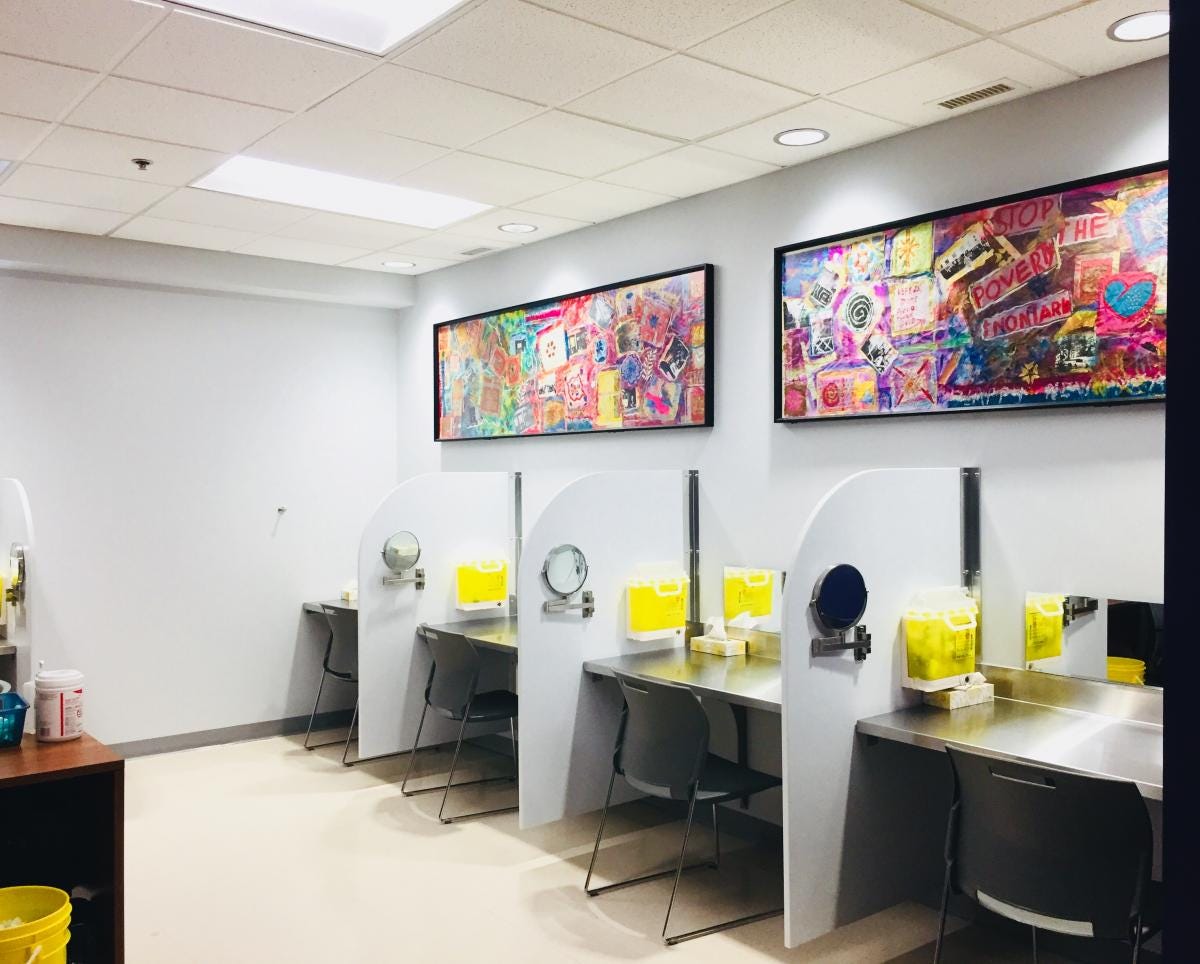
In March, the Province announced that it would suspend all funding for Consumption and Treatment Service sites (sometimes called “supervised injection sites” or even “safe injection sites”) in Ottawa. That effectively means a forced shut-down by June 13 for two sites in Ottawa1.
Shutting down these services is like removing defibrillators from community centres, or taking life preservers away from beaches. The sites are staffed by trained professionals (for example, nurses and harm‑reduction workers) who monitor for overdoses and intervene immediately with oxygen, naloxone, and other emergency measures to literally save lives.
I’m sharing a memo sent last week to City Council from Dr. Trevor Arnason, Medical Officer of Health, Ottawa Public Health, and Clara Freire, General Manager, of Community and Social Services for the City of Ottawa. (I’ve added some highlights for emphasis.)
Subject: Coordinated local response to provincial decision on funding suspension of consumption and treatment service sites
On March 16, 2026, the Province of Ontario announced it will suspend funding for all Consumption and Treatment Service (CTS) sites across Ontario in communities that are supported by an existing Homelessness and Addiction Recovery Treatment (HART) Hub within 90 days. The purpose of this memo is to provide Members of Council with an overview of anticipated community and client impacts related to this decision and the City of Ottawa’s efforts to mitigate these impacts in partnership with Ottawa Public Health (OPH).
Anticipated impacts
The current CTS sites in Ottawa (Ottawa Inner City Health and Sandy Hill Community Health Centre) are expected to close as they will no longer be financially viable with the suspension of provincial funding. It is anticipated that this will cause a series of impacts to clients, including increased likelihood of overdose and subsequent adverse health outcomes such as brain injury and death. In Ottawa, there are currently approximately 1,750 unique clients who access the CTS sites annually. Clients will often access these sites multiple times in a day or week. On average combined, these sites see approximately 5,500 client visits per month. And while HART Hubs operate in Ottawa, they do not provide the supervised consumption or harm reduction services that these clients seek.
It is expected that with more incidences of overdose, there will be additional pressures on emergency first responders (paramedics, fire, special constables, and police), local hospitals and other community health and social service resources.
Additionally, the closure of these sites is also likely to lead to more visible drug use, social disorder, public safety concerns and increased discarded drug paraphernalia in the community, putting additional pressure on municipal services such as By-Law, Public Works and Transit Services.
Coordinated local response
The Ministry of Health has recently identified Ontario Health (East Region) as the lead agency responsible for convening local interest holders on plans to address the closure of CTS sites. OPH and the City of Ottawa are engaging with Ontario Health in this planning. Additionally, continued engagement of key groups, like the Ottawa Overdose Prevention and Response Task Force and the ByWard Market Revitalization Steering Committee, along with regular sharing of data amongst partners has strengthened the capacity for information sharing and mitigation planning within existing mandates and resources.
New and ongoing services for clients
OPH continues to provide harm reduction services including naloxone distribution and referrals to health and social services through its clinic at 179 Clarence Street and mobile harm reduction van. Additionally, OPH partners with over 45 community agencies to offer harm reduction services across the city, including community health centres, drop-in centres, supportive housing sites, and Indigenous-led services.
Recognizing the increase in demand to serve clients in the downtown core of the city while needing to maintain response times across the municipality, the Ottawa Paramedic Service deploys an Advanced Care Paramedic in Lowertown (ByWard Market and Sandy Hill) and Centretown neighborhoods. These paramedics receive enhanced and ongoing training in substance use health, substance use disorder, mental health, and wound care. Additionally, they receive training in cultural considerations, including Indigenous Cultural Safety training. They provide preventative and urgent care, outreach and regularly collaborate with community partners.
To improve care options for clients, the Ottawa Paramedic Service has partnered with Inner City Health and The Ottawa Hospital on the Targeted Engagement and Diversion program.
Paramedics are also permitted to transport patients to the Shepherds of Good Hope, which provides ongoing medical attention, monitoring, and care coordination for patients who are unhoused or precariously housed.
Additionally, to better serve clients seeking housing and other health and social services support, the Community and Social Services Department is strengthening its outreach and community response through the Unsheltered Homelessness Outreach Model (UHOM). City staff are collaborating with community service providers to redesign an outreach model that consolidates 11 providers under a single coordinated lead agency to improve integration, data sharing, responsiveness, and real-time case management. Starting in September 2026, a new centralized dispatch and assessment function, accessed via 3-1-1, will support this work and will provide residents, businesses, and clients with a clearer and more reliable mechanism to report concerns. The selected agency and transition strategy will be announced in June.
Other community resources and services
To respond to discarded drug paraphernalia, the City has enhanced its monitoring and retrieval of needle and drug use equipment this year. Residents can report incidents of discarded needles and drug equipment through 3-1-1.
In addition, Public Works provides enhanced cleaning services in several key downtown areas including the Preston Street Business Improvement Area (BIA), Chinatown BIA, Downtown BIA, Centretown BIA, Downtown Rideau BIA, the ByWard Market, and Elgin Street. In the ByWard Market, dedicated crews provide 24/7 patrol and cleaning operations to support the area’s high activity levels. Across the remaining downtown business improvement areas and corridors, locations are actively patrolled during daytime hours and supported by 24/7 operational crews when required. Ongoing monitoring ensures timely response to hotspots and helps prevent overflow, supporting a clean and safe downtown environment. Key maintenance activities include active patrolling, street and sidewalk sweeping, debris and litter cleanup (including biohazardous materials, sharps and hazardous waste), and collection from on-street bins.
To further support the initiatives outlined above and in response to increased public safety and security concerns in the transit network, OC Transpo is in the process of implementing a comprehensive Public Safety Strategy. This strategy is composed of eight key pillars supported by various activities, initiatives, and programs designed to improve safety and security throughout the entire transit system. Examples of initiatives include the new Special Constable Unit (SCU) Community Visibility Team, enhancing safety in public washrooms on the rail network including the installation of secure needle drop boxes, and exploring further partnership between the SCU and existing City outreach teams, the Ottawa Police Service and external partners to jointly provide aid to individuals in mental health and/or substance use crisis. Station cleaning activities, including the removal of discarded needles, vandalism, and graffiti continue to be a key area of focus. All Special Constables receive extensive training, including medical first responder certification and how to properly and safely administer naloxone.
OC Transpo is revitalizing the Rideau Station as part of a Crime Prevention Through Environmental Design review. This work will help to support other City initiatives, including the ByWard Market Revitalization Framework and Action Plan. OC Transpo is currently evaluating the feasibility of a dedicated public-facing SCU operations hub at Rideau Station which is anticipated to enhance visibility in addition to safety (both actual and perceived) in one of the transit system’s highest-demand locations.
Additionally, the City is providing $500,000 annually for two years, beginning in 2026, to the ByWard Market District Authority to fund enhanced security measures. This initiative will prioritize the safety and experience of residents, visitors, and businesses by providing a visible and approachable presence throughout the district, while working closely with partner agencies to connect individuals to appropriate services and coordinate responses to emerging issues.
Further safety and security enhancements in the ByWard Market and the downtown core are also before Council’s consideration on May 27. This report recommends reallocating funding from the Ontario-Ottawa agreement to a series of implementation-ready initiatives that support public safety, placemaking, accessibility, economic activity and the visitor experience.
As well, in order to enhance public safety in the ByWard Market, Rideau Street, Lowertown, Sandy Hill and Centretown areas, the Ottawa Police Service’s Community Outreach, Response and Engagement (CORE) Strategy focuses on reducing crime in specific areas of Ottawa by addressing root causes. Objectives include safer communities, decreased crime, support for vulnerable community members and community-led solutions.
Key components of CORE include the Neighbourhood Operations Centre (NOC), located in the Rideau Centre, which serves as a vital coordination hub to enhance police presence and collaboration with local partners. It focuses on enforcement efforts, on addressing the root causes of low-level crime, and on community engagement, which is at the heart of the strategy. CORE is actioned by increasing visible police and Special Constable presence in high-priority areas to deter and prevent crime, enhance safety and provide visible reassurance to the community.
Recognizing that many low-level, non-violent crimes are linked to complex issues such as substance use, homelessness, and mental health challenges (areas where traditional law enforcement and criminal justice solutions are not effective), OPS has collaborated with over 30 community partners to develop the Integrated Community Situation Table. The program offers comprehensive wrap-around services, including medical care, addiction treatment, mental health support, legal assistance, and housing options.
Next Steps
OPH will continue to engage with Ontario Health and other partners, and the City will coordinate municipal services among key departments, including paramedics, police and public works to mitigate and manage impacts related to expected CTS site closures. There is no new funding to enhance responses.
Staff will continue to provide City Council and the Board of Health with updates as this process unfolds.
Sincerely,
Dr. Trevor Arnason, Medical Officer of Health, Ottawa Public Health
Clara Freire, General Manager, Community and Social Services
Ottawa’s two remaining CTS sites are at Sandy Hill Community Health Centre, and a trailer operated by Ottawa Inner City Health at the Shepherds of Good Hope in the ByWard Market.
- comparing safe consumption sites to defibrillators in community centres is ludicrous. No one chooses to have a heart attack, all drug addicts have at some point made a conscious decision to start to use drugs.
You predict more disorder after closure, but how much disorder was already associated with the sites themselves? You are assuming these sites reduced public disorder, but provide no evidence for that claim. Therefore the prediction that closure will worsen neighbourhood conditions should not be accepted without supporting evidence. Indeed, other neighbourhoods have recovered when their sites were closed.
As a councillor 40 km away from the downtown core, you and your constituents (which certainly wouldn't welcome injection sites in their neighbourhood) are largely insulated from public drug use, disorder and trespass to property including arsonists and squatters, dealers, gang and associated gun violence, needle and crackpipe litter, open prostitution and coerced sex work, shuttered businesses -- and I am pretty sure no daycare in Stittsville was forced close due to the dangerous drug addicts and school recess doesn't require police escorts.
You have a right to your opinion, but as an elected official you should be mindful about representation especially when advocating for a policy that you are unaffected by.